Tuesday, August 21, 2012

Angkor Wat pictures uploaded

Pre Rup at sunset
Hello all, we've just touched down in New Delhi and had quite the adventurous little day, which I'll be sure to fill you in on a little later. Before making any other posts though, I wanted to catch up on uploading all our pictures. I've started with those from Angkor Wat, but as the files are pretty big, the rest will have to wait until tomorrow when I get over to an internet cafe for some real throughput. (hostel connections don't cut it for the heavy lifting!)

I've also uploaded a bunch of food pictures from our meals in Cambodia—I have a feeling this will become an ongoing theme.

To see what's up already, just click on the Flickr button on the right side of the blog to go to my Flickr photostream. Keep an eye here over the next few days, there's sure to be more coming!

Monday, August 13, 2012

The Cambodia Express: Bangkok to Siem Reap

Yesterday, we endured the first harrowing ordeal of our young journey. Having completed our business in Bangkok, we set off for our first new (to us) destination: Siem Reap and the temples of Angkor Wat. Many online sources make this trip seem all kinds of scary, but for us it was relatively straightforward and cheap, albeit crowded. That last part was partially our fault though as we did the trip on a Saturday morning on a Thai holiday.

The abbreviated sequence of events went like this:
  • Train from Bangkok to Aranyaprathet
  • Tuk-tuk from Aranyaprathet to Poipet (Cambodia border)
  • Get visa and walk across border
  • Bus from Poipet to Siem Reap
The whole trip cost us about $35/person, most of which was spent on the Cambodian side for the visa and bus. Here's a little more info on each step.

1. Bangkok to Aranyaprathet. First off, the Thai side of things is cheap and simple with two options: bus or train. The train is a shocking 48 Baht per person (roughly $1.50/120 yen), leaving Hua Lamphong Station at 5:55 am and arriving just before noon or leaving 1:05 pm and arriving around 5:30 pm. The morning train is the only way to do the trip in one day, however.

On the train to Cambodia
It's a scenic ride and the seats are comfortable enough... as long as you don't decide to go on the Queen's Birthday or some other Thai holiday. Not only did we not check the calendar, we also got to the station with only 5 minutes to spare, inevitably standing for half the trip in a train—easily as crowded as Tokyo trains, by the way—until a kind soul was nice enough to give up his seat to Akemi. We stood for the first half of the ride in crowded quarters and sat for the last half.

The other option is a bus, which will reportedly set you back about 150-200 Baht. I'm sure the seats are more comfortable than the train, and a friend tells us the view was good as well. Personally, however, I'd try the train at least once for the experience.


2. Aranyaprathet to Thai-Cambodia border. You're pretty much stuck taking a tuk-tuk the 6 km it takes to get from the train station to the border. Online I read to expect 60-100 Baht for the ride, but we had no problems grabbing a third person and getting the driver to do 50 Baht, split three ways.

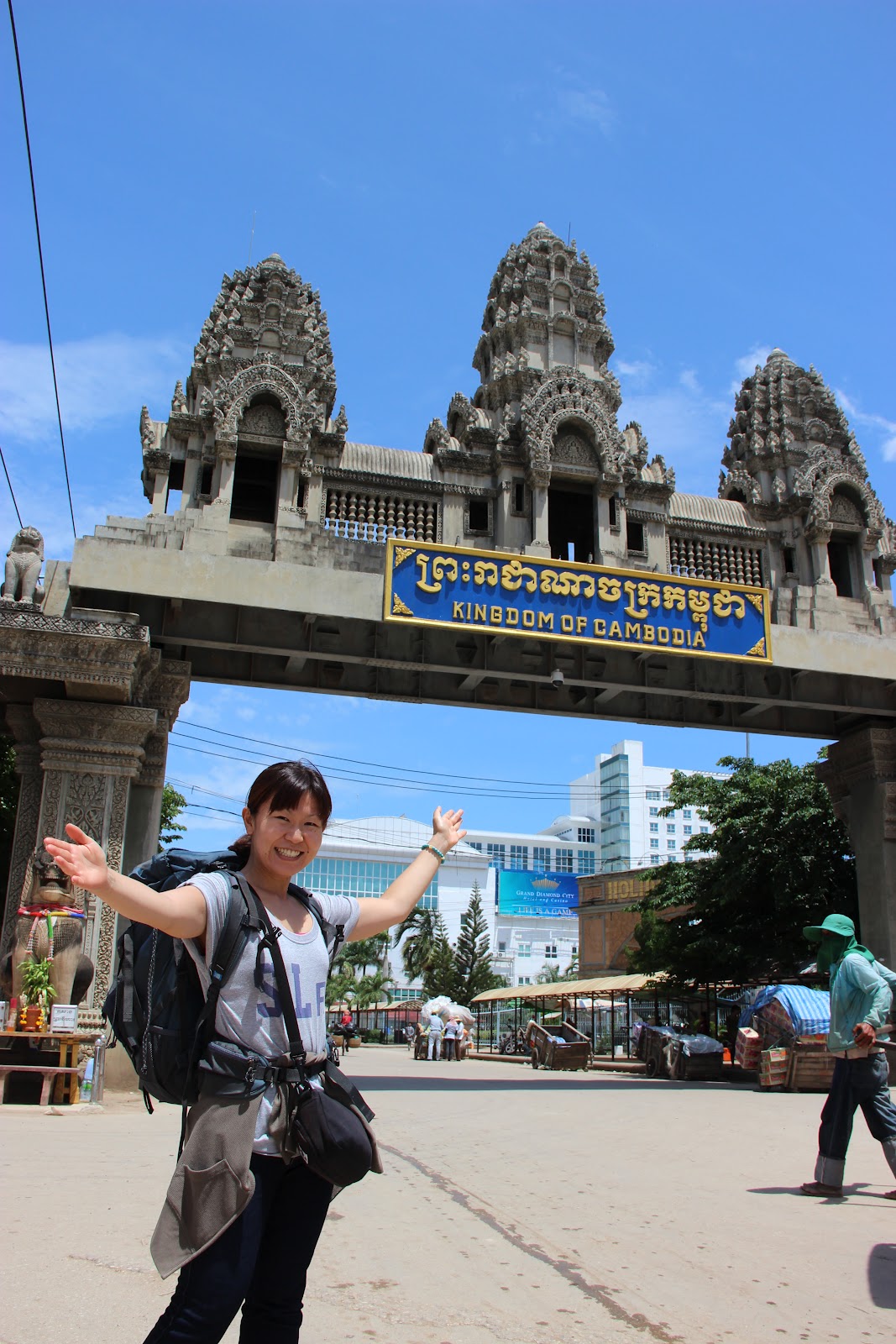
Cambodian border
3. Border crossing process. Here's where you have to be careful—DO NOT listen to anyone trying to sell you a visa before leaving Thailand. If you didn't get an e-visa online beforehand, they do visas on the Cambodia side after Thai immigration stamps your passport. The tuk-tuk took us to a certain point, but we had to walk another 500 meters or so to the border ourselves. It was pretty crowded for us (again, it was a holiday), so took over an hour total.

For the visa, they charge $20 plus 100 Baht (not sure why they do it that way), and you'll need a passport photo. While this was time consuming due to the crowds, no one used to touts in Thailand should find it that treacherous to avoid the border scammers.
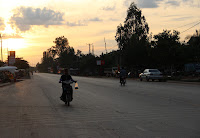
Newly sealed Cambodian highway
4. Bus to Siem Reap. This is one area that has vastly improved in recent years from what I've read. What used to be quite a bumpy ride is now a fully paved road that will take an uneventful three hours by bus. There's a free shuttle bus from the border to the terminal where you can choose a bus for $9 (or 350 Baht I think), minibus for $10 or taxi for $12 (with four passengers). We took the bus, but it waited a good hour until there were enough passengers to fill it. If I had to do it again, I think I might splurge and pay an extra $1 for the minibus.

That's it! Siem Reap is more than just Angkor Wat; it's a great little town with excellent food and bustling night life, and things are dirt cheap. A backpacker's paradise! We've only been here one full day, but are loving it thus far. Did I mention that the food is amazing?? I'll leave you with a picture of our $5 lunch for two today. The sauces here are fantastic.

Thursday, August 9, 2012

Trip preparations: Immunizations


Thailand and India are two of the world's biggest destinations in terms of medical tourism. Both countries are rather well developed in terms of medical facilities (often comparable to Western countries) and have doctors fairly competent in English without being too expensive. Especially if you're coming from an expensive area like the US or sometimes even Europe or Japan, these countries offer a viable alternative for routine procedures and even some more complicated procedures.

As I alluded to in our last episode, our destination for the last couple days has been the snake farm at the Queen Saovabha Memorial Institute in central Bangkok just north of Lumphini Park. As you may have guessed though, the snake farm wasn't what we were after—it was more about the immunizations.

Queen Saovabha Memorial Institute
Immunizations are an important step in preparation for any long trip, but the shots can get pricey, especially in Japan. Japan only seems to offer vaccinations for diseases which occur locally, meaning most vaccines for things like typhoid and yellow fever have to be imported. After checking others' experiences, it appears that the shots we wanted to take would be about 70,000 yen in Japan; we got the same done in Thailand for just 5,205 Baht (roughly 13,000 yen), less than 20% of the Japanese cost. Here's the price comparison breakdown:

Exchange rate: 1 JPY = 2.484 THB
 
Japan (JPY)
Thailand (THB)
Thailand (JPY)
Hepatitis A
8,400
1,400
3,478
Yellow fever
7,700
900
2,236
Typhoid
11,550
305
758
Pertussis/tetanus/ polio/ diphtheria
6,400
700
1,739
meningitis/ Meningococcal
14,000
1,200
2,981
Measles, mumps, rhubella
13,650
250
621
Japanese encephalitis
7350
450
1,118
Totals
69,050
5,205
12,930

First three of our shots
Now some vaccines are supposed to be administered in 2-3 shots spaced a few weeks or months apart for full effect, which is why most doctors will recommend you start getting shots a month or two before leaving. Given the price differences, however, we tried researching how long the first shot would carry us. The hepatitis A vaccine recommends a booster 6-12 months after the first shot, so it should last about the length of our trip. The only other shot we got that requires a second jab is Japanese encephalitis, and honestly you can probably skip that one. After the fact, we looked this up online and found that it is really only a high risk disease if you plan to be in rural areas of SE Asia, which we do not.

That leads to the question: how do you decide which immunizations to get? In addition to the above, doctors will often mention hepatitis B and rabies shots. As a married couple, we're not to concerned about hepatitis B. As for rabies, and getting the vaccination doesn't prevent you from going to the hospital if you get bit; it only gives you more time to get there before things get ugly. In general, CDC and WHO are great resources for researching immunizations and other health issues.

Akemi wearing her mini badges
of honor like a boss
If you decide to do like we did and get your shots on the road, I'd recommend taking it easy for a day or two. Both of our arms are as sore as a virgin on prom night, and we sacked out for a few hours after getting back from the clinic today. I'm thinking tomorrow will be a good day to take it easy and catch up on a bit of work that's trickled in.

Also note that the clinic will only let you get four shots in one visit. We wound up breaking our shots up over two days. Honestly, given how I feel right now, I don't know if I'd want to take seven jabs at once. Ouch!

Lastly, either show up early or just wait until 1 pm. We got to have lunch there just to wait for them to open back up.

Snake farm behind the vaccination center
So where does the snake farm part come in? There's a snake farm out back that you can check out for 200 Baht a head. We didn't bother, but a bunch of people seem to find it pretty interesting. I guess we're just cheap. ;)


Now malaria is a totally different subject, but I'll leave that one for another time.

Tuesday, August 7, 2012

One night in Bangkok

Well things got off to a little bit of a rocky start, but we are now settled into our hostel in Bangkok and ready for action.

In the morning, we got to the airport with no problems, but then got stuck waiting in line to check in for our flight; of course we weren't checking any baggage, but the kiosks were down and we missed the 2-hour cutoff for online check-in. I'll take that as a useful learning experience.

Then once we got checked in, the rains came. The deluge gave us a good hour in the plane on the runway to watch a movie and also wound up extending the flight itself a bit as the pilot dodged a typhoon.

Now in Bangkok, it was dark by the time we finally took the 30-minute train into town. I think back now to the first time I visited Thailand and split a taxi with a few guys and cannot begin to express what an improvement the train is; I can't imagine why anyone would put themselves through the taxi rigmarole now. Seriously, as long as it's not past midnight, just go down to the basement and take the train—it's faster and cheaper.

For our destination within Bangkok, we went with a friend's recommendation and settled on the centrally-located Silom district. It's right in the middle of things, has good access to public transportation (5 mins. walk from the station to our hostel), and is walkable to the river, Lumphini park and even Patpong if you're feeling frisky.

I looked up a few hostel options before we left with a handy iPhone app I found, and we set out for one upon arrival. It paid off for us not to make reservations; any place that has an opening for that night would rather give the room to you at a discount rate than let it go unused, which was good for a no-haggle discount. Our private hostel room is clean, spacious and comes with WiFi and AC. Sounds like a perfect place for me to get some work done tomorrow!

Now that we've finally flown over and gotten settled, this is finally starting to feel like a trip—the adventure starts here! Tomorrow, we get to visit a snake farm.
Enjoying cold libations at the hostel after a long day

Monday, August 6, 2012

Takeoff!


I write this from a business hotel in Narita, awaiting our flight to Thailand in the morning. After doing one last run through all our stuff to complete a proper packing list, the fam ran us over to the shinkansen station to see us off.

I'm sure they have the same concerns any parent would have for their kids in such a situation, but I know they're excited for us as well--a trip around the world is a dream of her dad's that we get to live out for him.

Our bags are packed and we've said our goodbyes. Next stop: Bangkok!


Saturday, August 4, 2012

Trip preparations: travel insurance

Insurance may not exactly be the most exciting subject in the world, but with a big trip like this it becomes a major consideration. We thought long and hard about things, and after going through all our options decided to go with World Nomads for our travel insurance. This seemed to give better bang for the buck than Japanese alternatives with higher payouts, and we even found a promo code for 7% offjust enter VOYGNR at the checkout. Total cost to us: $2,604.14, or $1,302.07 per person.

Our policy covers things like the standard medical costs for emergency treatment on the road and repatriation if it looks like you need more serious care as well as travel-related risks, like trip cancellations, missed flights or lost/stolen passports. It also covers stolen goods in general, but from what I've heard I won't expect too much in that regard. For a full list of what's covered and what's not, check out their site.

I actually read through the entire 50-something page insurance policy on the World Nomads website, and even called to confirm some things. The majority of those complaining about insurance issues didn't seem to know much about what was going on with their policy in general. Don't expect to get much if you haven't even read what they require to process a claim.

Here are a few tips from my reading:
  • Read your policy. Did I mention that already? Because seriously, you should go do that now. Know what your policy does and doesn't cover, as well as what it's limitations are. Many policies will exclude coverage in expensive countries like the US, so be sure it covers everywhere you want to go.
  • Don't leave yourself open. In big bold letters near the very beginning, the policy I read stated that they won't insure you against theft that you could've prevented by not being stupid. Don't leave your bag unattended or with someone you don't know, keep it within reach, always lock it up, and when you do set it down, either keep the bag wrapped around your leg or even lock it to yourself with a small chain or zip tie. Don't be like Billy Bonehead and walk around with a backpack pocket wide open (like I always do) or stick anything you don't want stolen in your back pockets. Common sense: use it.
  • Pack light. Not only will this make your life easier in general, but it also makes things safer. With a smaller bag, you don't have to check bags on a flight or put it above the bus, so it's always right with you. Also, when you take a taxi, it can ride with you instead of being stuck in the trunk where it can be either forgotten or held ransom as the driver's last ditch effort to squeeze a few more pesos or rupees out of you.
  • Follow the rules. Unless you abide by the law, insurance won't pay. If, for instance, you rent a scooter somewhere without the legal right to ride said scooter, don't expect them to pay for anything that happens to you, even if it is the other guy's fault. 
  • If something happens, call first. If anything happens that you think will require a claim and you aren't passed out or something, just about every clause mentions to call them and notify them of a possible claim. If they don't approve of something, it gives them another chance to refuse your claim.
  • Keep papers in order. If you do wind up making a claim, make sure to keep all your receipts from purchases and get all your paperwork in order. It's pretty simple to get a signed receipt from a doctor, but can be harder in some places to get say a lazy police officer in a third-world country to write you a police report for something stolen out of your bag that he knows you'll never see again. In some cases, I've heard it might even require a bribe to loosen his pen for you. Also, if something happens in a hostel or hotel, you need to report it to staff there.
  • Don't expect full value. The impression I get from looking around is that while policies will normally protect you in the most dire of cases, most any insurance company will also do whatever they can to limit how much they pay out in the end. This goes doubly true for stolen goods; see the second note above.
Got any tips of your own about insurance, or any horror stories to show us what not to do? Lay 'em on us.

Wednesday, August 1, 2012

Last weekend in Tokyo

Going away party at Rojo in Koenji
There really is no excuse for leaving a city like Tokyo without a bang, and I’ve never been one for making excuses. We had a great weekend with many friends—we saw Batman followed by a well overdue karaoke session on Friday, had our official farewell party at our favorite local Mexican restaurant with a great turnout complete with obnoxious belligerence (and it wasn’t even me this time!), and had drinks with a couple friends at an awesome yakitori place just outside my old apartment on Sunday.

All I can say after six years in Japan is that I really do have some interesting friends, and I hope the feeling is mutual. I got a ton of great advice as well from some of my more well-traveled friends. For instance, two people told us to watch ourselves in Salvador if we decide to go there for Carnival (a distinct possibility), and another mentioned that Phnom Penh is not a place to be out and about after dark. We have also added the wrestling cholitas of Bolivia to our "must see" list.
My last kampai in Tokyo for a while

This just highlights to me that more than guidebooks, you really do need to just ask people that have been there before, or even better some locals once you get there. Research beforehand is definitely an important step not to be skipped, but there really is no replacement for personal experience. That, and I look forward to wandering off and finding my own little gems along the way, even if it means getting lost. Seeing the big sites is great, but sometimes the biggest highlights of the trip are those places or things that you find yourself—it really makes it feel like your own personal trip and not some preconceived, cookie-cutter tour. I guess you could call it making a trip into an adventure.

Well, here is where the adventure really starts to pick up: we’ve sold or tossed probably around three-fourths of our worldly possessions, left our apartment behind and are heading up to Miyagi for a week. Miyagi is Akemi’s home and my unofficial home away from home, so we both have a bunch of people we want to meet before setting off.

Urge to travel: rising!